Academic core
AI + Cybersecurity
Year 3, Semester 1 / fifth semester out of six (Semester 2, 2026)
ChiaOS activation sequence
Clean setup handed off to the activated system.
System status
Ready for inspection.
Code. Learn. Build. Evolve. ChiaOS is the full-send layer: 3D direction, local assistant logic, mission proof, Realfun operations, and career identity arranged as one product experience.
Primary signal
AI-first
Operating proof
Realfun
Build style
Vibe coding
System Director
The fixed 3D layer reacts to the section in view, mission focus, and skill focus. It behaves like a visual director rather than a decorative background.
Active layer
Scroll-guided 3D
Focus loop
Mission + skill cues
Motion
Reduced-safe
Identity
AI-focused Computer Science student building through cybersecurity, practical systems, and AI-assisted development.
Core signal
Creative development, vibe coding, and practical career direction.
system snapshot
Based in Kuching, Sarawak, Malaysia, ChiaOS compresses Chia's current status into scan-friendly modules before opening the deeper mission archive.
Academic core
Year 3, Semester 1 / fifth semester out of six (Semester 2, 2026)
Mission files
Projects across AI, design, cloud, database, and networks.
Operations scale
Hotline, scheduling, events, and urgent changes.
Operating style
AI-assisted iteration grounded in real evidence.
Swinburne snapshot
Cumulative, as of the last completed semester.
Foundation
Completed July 2024
Education route
Double majoring in Artificial Intelligence and Cybersecurity. Expected graduation: Around June or July 2027, if everything goes well. Cumulative CGPA 3.51 as of the last completed semester.
operations module
Part-time Admin / Hotline Handler at Realfun Learning Centre, Miri Branch. May 2023 to Present. Major real-world operations experience coordinating parents, students, teachers, class changes, online support, and urgent communication under pressure.
Case response
When Tynker access broke down, Chia handled incoming messages and calls, guided teachers toward backup special projects, and helped classes keep moving.
200+ contacts handled
Around 130 students supported
30+ weekly class slots coordinated
Almost 24/7 support when needed
Parent, student, and teacher coordination through daily operational channels.
Class replacements, reminders, and updates kept moving without drama.
Turning scattered requests into clear next actions for the right people.
Operating surface
mission files
Each featured project has its own artifact. Pick one to inspect it in 3D, then open its case study for the measured results and stated limits.
Earth data record
Space · NASA Space Apps Challenge 2026
A multisensory Earth Information Jukebox prototype that turns a NASA visual and NASA GISTEMP observations into browser-generated sound, with the mapping kept visible.
Groove reading
2025 · +1.19 °CAnomaly vs 1951–1980 average. NASA GISS GISTEMP v4, annual global anomalies, data checked 14 October 2026.
How to read it
Each groove ring is one year of global temperature, 1880 on the outer edge to 2025 at the label. Blue years were cooler than the 1951–1980 average; gold to red years were warmer. The tonearm plays the record year by year, like Earth FM turns observations into sound.
Real data: NASA GISS GISTEMP v4 annual anomalies, as bundled in the Earth FM repository.
Space · NASA Space Apps Challenge 2026
A multisensory Earth Information Jukebox prototype that turns a NASA visual and NASA GISTEMP observations into browser-generated sound, with the mapping kept visible.
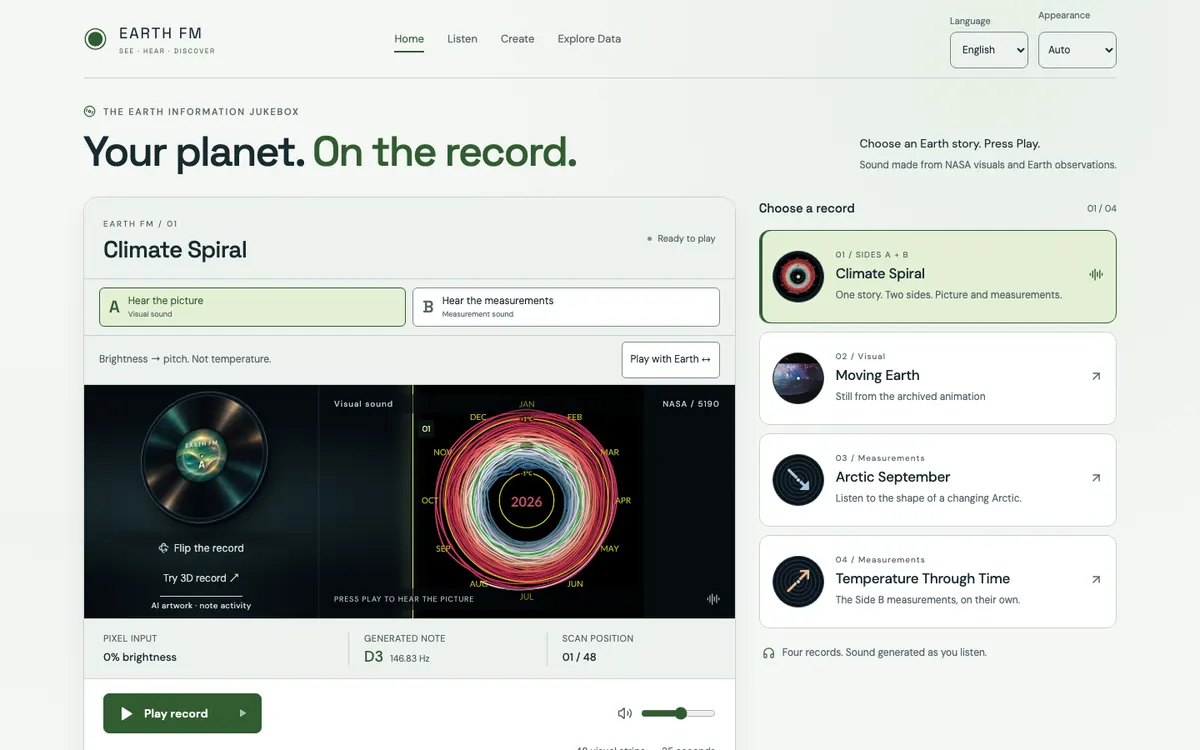
Earth visualizations can be engaging but hard for a first-time learner to interpret. The challenge asked for visual frames paired with dynamic, real-time sonification.
Chia led team BoboMimi, a two-person team with Jacy Chiong Yet Suu, and contributed to development and integration. The delivered app is shared team work, so features here are credited to the team.
Limits: No participant study has been run. Learning effectiveness and screen-reader and physical iPhone behaviour are not yet established.
Evidence: Repository README and docs/SUBMISSION.md, checked 13 November 2026.
Fintech · COS40005 Project A, client: Sarawak Artificial Intelligence Centre
AI-driven financial analysis and automated reporting for the Sarawak Artificial Intelligence Centre (SAIC): ingestion, reconciliation, anomaly review and management reports with traceable evidence.
Finance teams reconcile bank and ledger records, investigate unusual movements and write management reports by hand. Each step needs evidence a reviewer can trace back to source rows.
Led the data-ingestion workstream: deterministic CSV/XLSX ingestion, validation, normalization and source lineage. Also contributed to AI-assisted ingestion workflows and application integration. Teammates own the analytics, backend and security components, and this case study describes the team's shared system.
Limits: Results come from synthetic data, not client files, and do not prove accounting correctness. Several AI features stay disabled in hosted production.
Evidence: Repository README, docs/handoff/CURRENT.md and the combined PoC runbook, checked 13 November 2026.
AI · COS30082 Applied Machine Learning, Assignment 1 (individual)
A fine-tuned EfficientNetB3 image classifier for 200 bird species, packaged as an educational Streamlit app with Top-5 predictions and documented limits.
Classify photographs into 200 closely related bird species, then ship the model so anyone can test it without a GPU.
Individual assignment (AS01): Chia fine-tuned EfficientNetB3 from ImageNet weights, evaluated it on the official test partition and packaged it as a Streamlit app. This is separate from the COS30082 group project.
Limits: The model only knows the 200 supplied species and will still label other birds or non-bird images. The hosted Streamlit app currently requires a Streamlit sign-in, so only the source is linked here.
Evidence: Repository README, verified results table, checked 13 November 2026.
Product · Supplementary prototype, based on the SWE30003 Assignment 01 case
A responsive React UI/UX prototype derived from the SWE30003 draft SRS, for discovering Sarawak, planning a multi-day trip and demonstrating a local listing-management workflow.
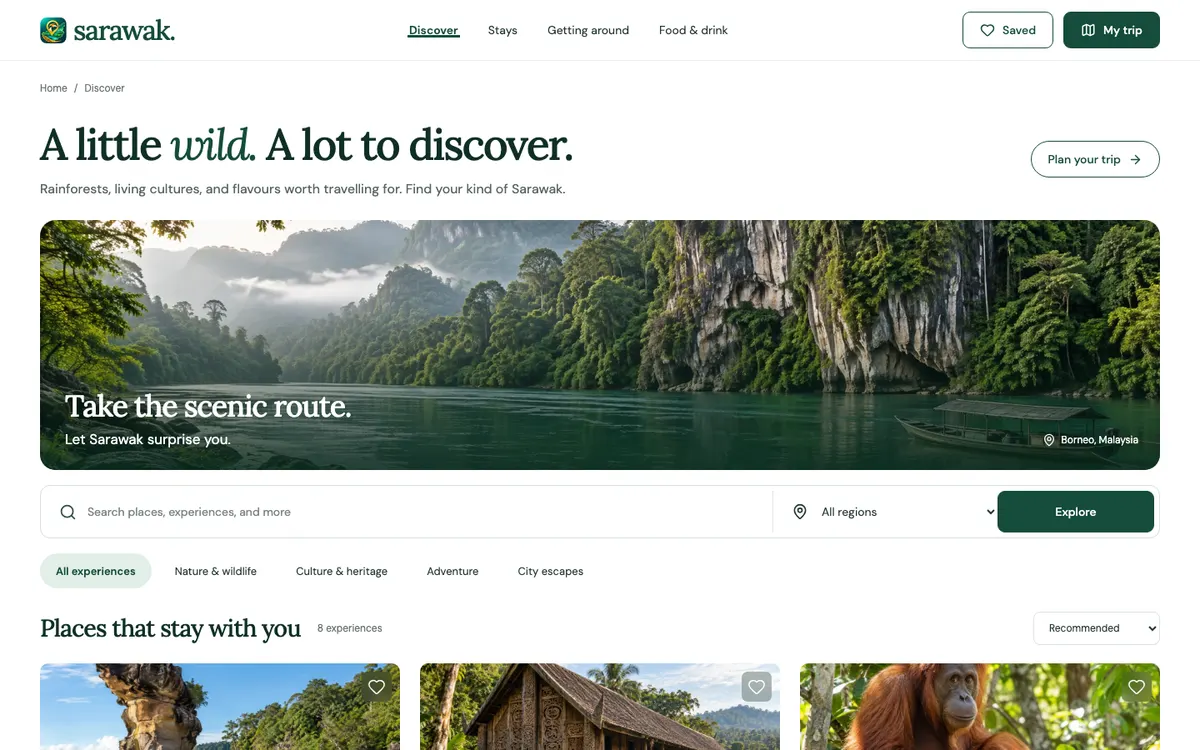
Turn an incomplete draft SRS for a Sarawak tourism system into a usable visitor and staff experience.
Supplementary UI/UX prototype work, maintained in Chia's public repository. It maps the draft SRS to working flows and documents design assumptions where the SRS was silent. It is not the completed SWE30003 assessment.
Limits: A UI/UX demonstrator only: no accounts, payments, real reservations, live availability or shared database. The management area is a local demo and does not meet the SRS's staff authorization requirement.
Evidence: Repository README, checked 13 November 2026.
Product · Personal product, June 2026 to present
A free, local-first PDF workspace for merging, splitting, reordering, compressing, annotating and signing documents in the browser, with no accounts and no uploads.
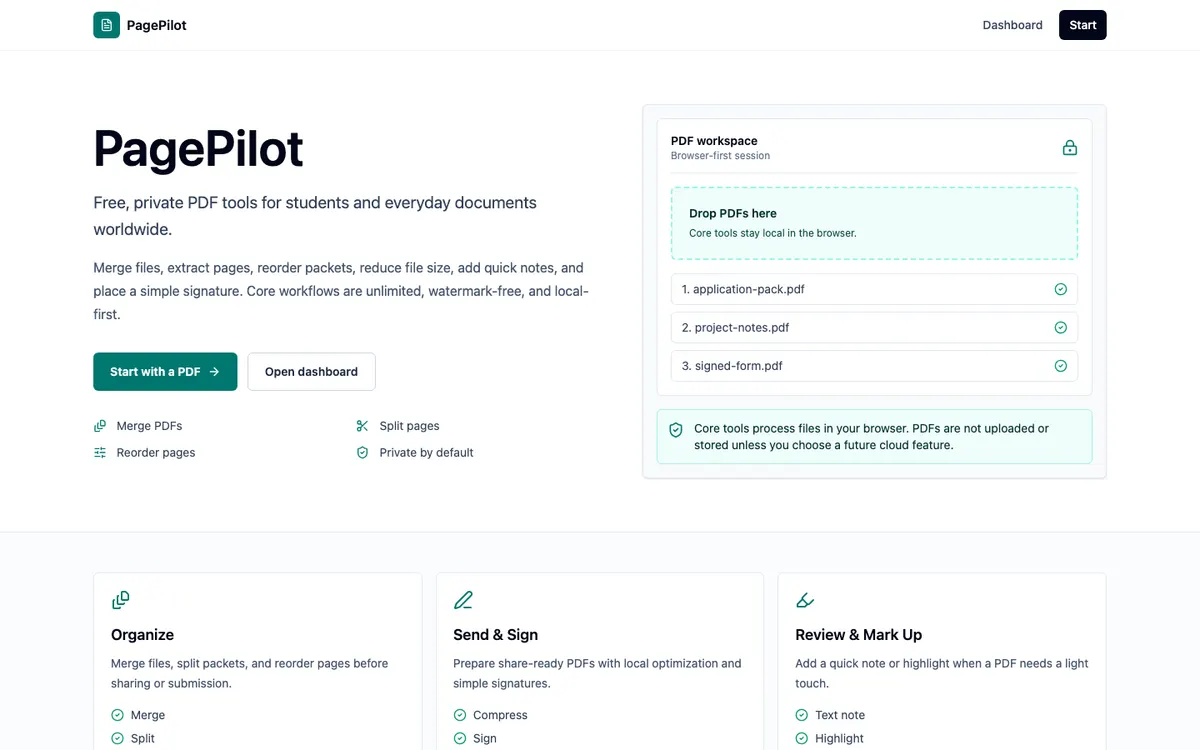
Students often need to merge, split, trim, sign or shrink a PDF right before a deadline. Many free tools upload the file, add a watermark or require an account.
Chia's own product: he defined the scope, the user experience, the technical direction and the browser-based PDF workflows. The source is private, so this case study uses only facts from the live product and its public pages.
Limits: Compression is structural optimization only: it does not downsample images and may not shrink every PDF. Notes and highlights are flattened into the export. Signatures are visual electronic marks, not certificate-backed digital signatures, and do not verify identity.
Evidence: Live product, /privacy and /terms (effective 16 August 2026), checked 13 November 2026.
Space · Built for the NASA Space Apps 2026 junior astronaut challenge
A junior astronaut mission trainer where students build a Moon or Mars outpost and balance power, oxygen, water, food and crew health over 14 turns.
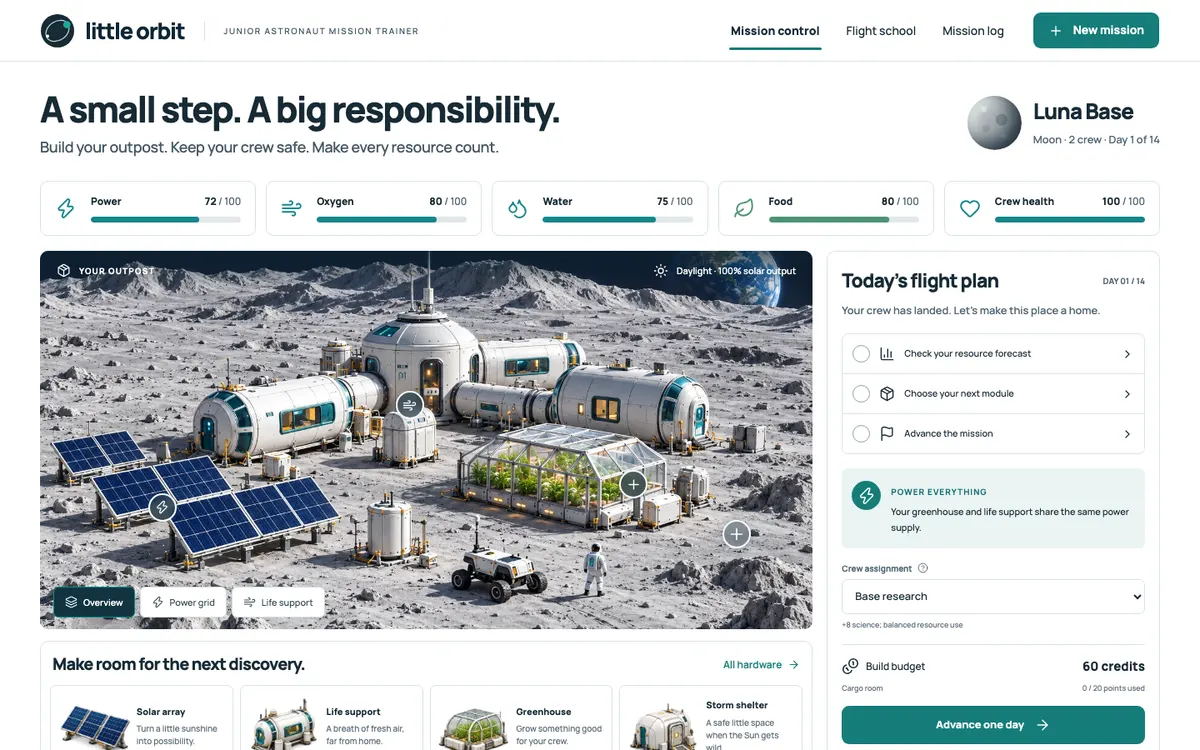
AI
Chia's flagship university project: an AI, full-stack, and system integration mission that represents one of his strongest current proof-of-work projects.
Currently the university project Chia is most satisfied with.
Negotiation · COS30018 Intelligent Systems, five-person team project
A JADE multi-agent car auction in Java: a broker matches buyer and dealer agents, who negotiate prices automatically or manually from a Swing dashboard.
Team project led by Jonathan Zheng Li Chai. Chia's documented role is agent communication and protocols.
AI · COS40007 AI for Engineering, Portfolio 4 (individual)
An individual deep-learning portfolio that trains YOLOv5 to detect graffiti, with annotation conversion, a dataset audit, three training iterations, IoU evaluation and error analysis.
The target was 32 of 40 test images at IoU ≥ 0.90. The default-configuration notebook reached 18, which the write-up reports and discusses.
Cloud · Four-person team project, March to June 2026
A scalable, event-driven AWS architecture for uploading, processing and delivering files, covering storage, identity, queues, media processing and edge security.
Architecture design project. There is no public repository, so this mission file is the public record.
Design a file-management system that scales with uploads, processes media and images automatically, and stays secure at the edge.
Chia led the four-member team that designed the architecture.
Limits: This was a design project. Load, cost and availability figures were not measured in a live deployment, and no public source is linked.
Evidence: Chia's CV (September 2026). Completion of COS20019 Cloud Computing Architecture is recorded in his Degree Progress Audit (August 2026).
Database
A completed university unit in relational database design: data modeling, normalization and SQL querying.
Project artefacts are not public yet, so no project link is shown.
Networking
A completed university unit in network design and switching, covering VLANs, subnetting, STP and EtherChannel.
Lab and portfolio artefacts are not public yet, so no project link is shown.
skill system
ChiaOS avoids inflated ratings. Each skill is shown with a current stage and the work that supports it.
Clusters
6
Evidence items
18
Primary direction
AI
cluster 01
AI is the main direction: model workflows, experimentation, and practical product thinking.
cluster 02
Focused on secure foundations, network behavior, and systems that are practical to operate.
cluster 03
Building practical web systems that connect interface, logic, data, and deployment decisions.
cluster 04
Architecture thinking for systems that need clear boundaries, reliability, and safe deployment paths.
cluster 05
Turning project details into structured data, readable proof, and maintainable records.
cluster 06
Using AI-assisted development to move faster while keeping proof, iteration, and clarity visible.
life os
The personal layer of ChiaOS: playful enough to keep building, serious enough to ship with proof.
Pick up a system, test the edges, and turn the lesson into visible proof.
Use AI-assisted workflow to move faster while keeping the final result personal.
Cut noise, improve the interface, and make the next version feel more like ChiaOS.
career timeline
Each stage adds another layer: fundamentals, web systems, data, security, AI, cloud, and the operating system that now ties the story together.
01
stage
Started with HTML, CSS, C, and programming basics.
02
stage
Moved into structured websites, PHP, and database integration.
03
stage
Explored KNIME, Python, model evaluation, and machine learning workflows.
04
stage
Built networking foundations around VLANs, subnetting, STP, and EtherChannel.
05
stage
Focused on real-time camera monitoring and evidence capture.
06
stage
Designed AWS-based scalable and secure architecture concepts.
07
stage
Created ChiaOS as a living career command center.
build logs
November 2026
Added Earth FM, FinGence, the bird classifier and the Sarawak tourism prototype as evidence-backed case studies with their stated limits, plus PagePilot and Little Orbit as public project entries.
June 2026
Defined the personal career operating system concept, Original Setup route, Activated System route, local data model, and deployment path.
Now
Turning coursework and technical projects into clearer proof points for internship and long-term career positioning.
Ongoing
Using AI tools to plan, code, review, and iterate faster while keeping the final site grounded in real local profile data.
roadmap
Now
Build ChiaOS, polish GitHub projects, prepare proof of work, and strengthen internship readiness.
Next
Pursue internship exposure in software, AI, cybersecurity, or cloud environments.
Later
Grow toward AI engineering, cybersecurity specialization, and cloud-native secure systems.
Long term
Create intelligent systems that are practical, secure, scalable, and useful beyond demos.
ask chiaos
The assistant uses the profile, mission, skill, education, experience, build log, and roadmap data already inside this site.
Local profile assistant
I'm Chia, an AI-focused Computer Science student based in Kuching, Sarawak, Malaysia. I study Artificial Intelligence and Cybersecurity at Swinburne, and ChiaOS is my personal operating system for showing project proof, Realfun operations training, AI-assisted workflow, and what I am becoming.
signal handoff
ChiaOS is built to show development taste, AI direction, operating proof, and career identity. The next signal can be feedback, collaboration, or a practical opportunity across AI and software systems.